Last month, I wrote about Jina… the friend I finally met in person! I keep thinking of the sweet little gift she brought me that makes me smile every time I see it, and it got me thinking about tiny little home made things that bring a smile to someone else.
Posted on September 18, 2025 by Suburban Farmgirl Nicole Christensen
It’s been a truly beautiful summer – none of the flooding we had last year, with lots of sun and humidity that was not too awful. Fall is off to a good start, as well. We have mornings and evenings with warm afternoons and sun, pumpkins gracing porches, and leaves are starting to change. The Autumn season is one of the most beautiful times of the year here on the east coast, especially in Connecticut! But there is something else that has everyone I know all abuzz!
Gardening has always been in my blood, from when I was a child and spent hours next to my Daddy, planting trees, vegetables and flowers, and inspired by my mama’s seasonal plants in pots. As an adult, I became a certified Master Gardener through the University of Connecticut extension in 2015, and then an Advanced Master Gardener in 2017. Since then, I speak to schools, Garden Clubs and other organizations on many different subjects of gardening.
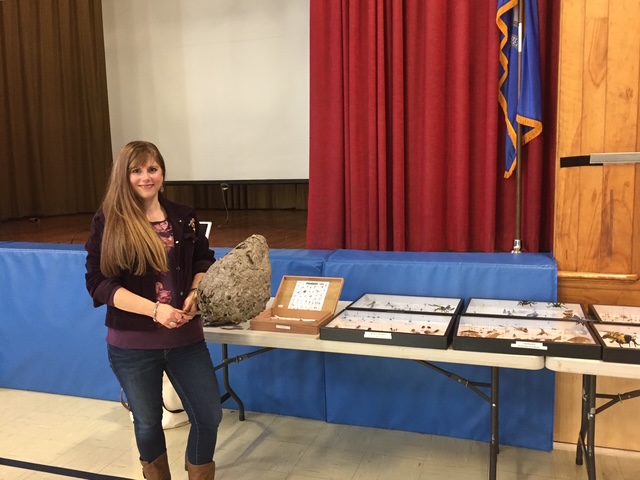
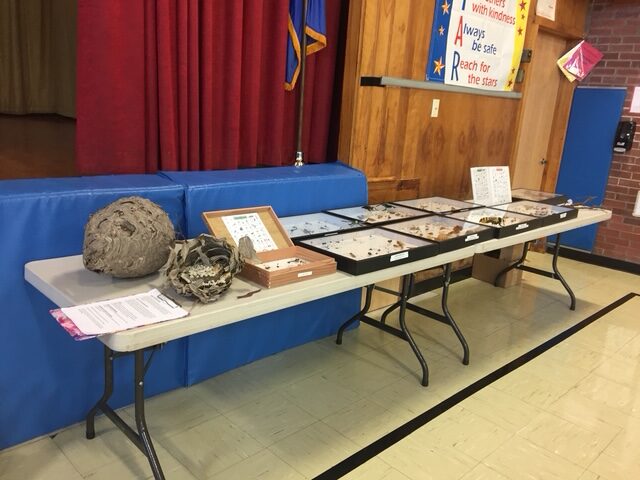
Since 2016, my “pet project” has been insects – identifying, labeling, and pinning, under glass, insects that are found in our area, for the extension office. These are used to help identify pests on plants that residents bring in, or for education purposes. While I am not an entomologist, I am so proud of my years of volunteer work on the insect boxes, and have learned so much in the process!
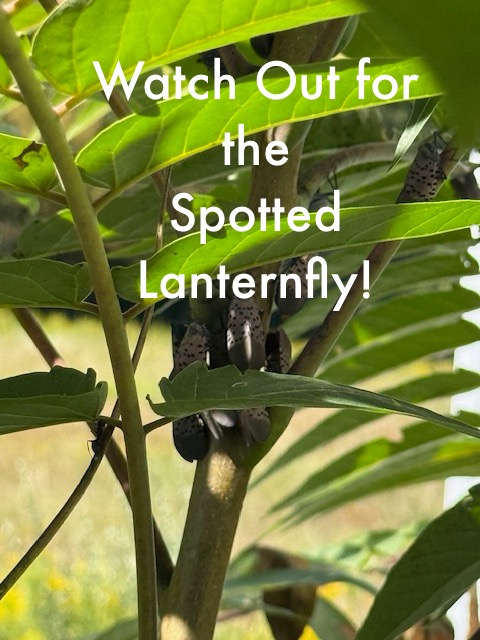
I love speaking to Garden clubs. I meet so many nice people, who all love gardening. This year, however, most of the questions I have been asked lately are about a dreaded pest, the Spotted Lanternfly, Lycorma deliculata, that has been making its way across the United States. If you have not seen them in your area, that’s a good thing, but everyone should be aware, as these invasive insects are quickly being found in more areas than ever. Even as I write this, my plans today have changed due to these insects. My daughter and I were planning on a “last bit of summer beach trip” today, heading to our favorite beach for an hour or two. We decided last minute not to go, due to a post on a local Facebook group on how all the Connecticut beaches right now are literally covered in Spotted lanternflies, divebombing and flying all over beachgoers. That sounds more like a horror movie to me, than a relaxing beach day.
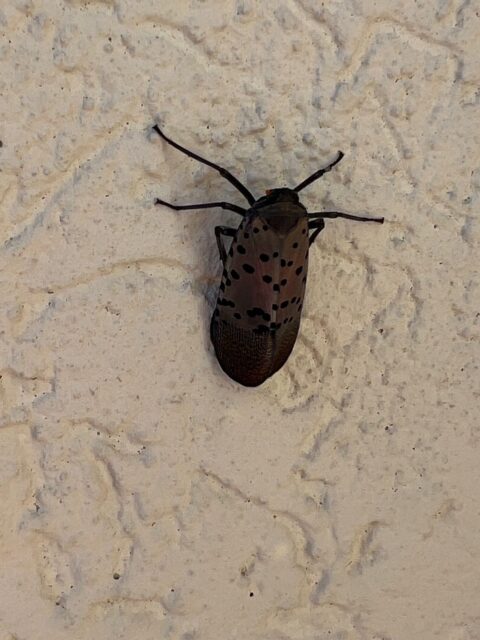
The first time I saw one “live” was a few years back, on the outside of a Costco near the Connecticut coast.
Originally from Asia, the Spotted Lanternfly was first spotted (pardon the pun) in the USA in Pennsylvania in 2014. While I personally saw and reported my first sighting along the coast two years ago, this year was my first summer seeing them in my hometown. Last fall, on a day trip to the Poconos in Pennsylvania to visit my friend, Robin, we were shocked and disgusted as we walked the sidewalk, as they were so numerous on the ground. We smashed as many as we could, and made sure to wash and inspect our vehicle before returning home to help stop the spread.
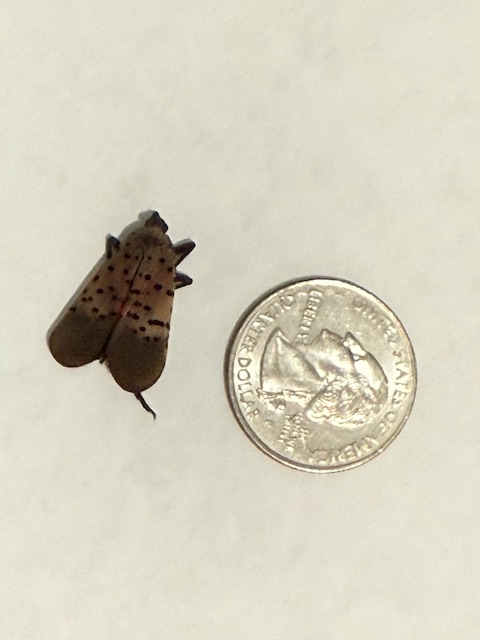
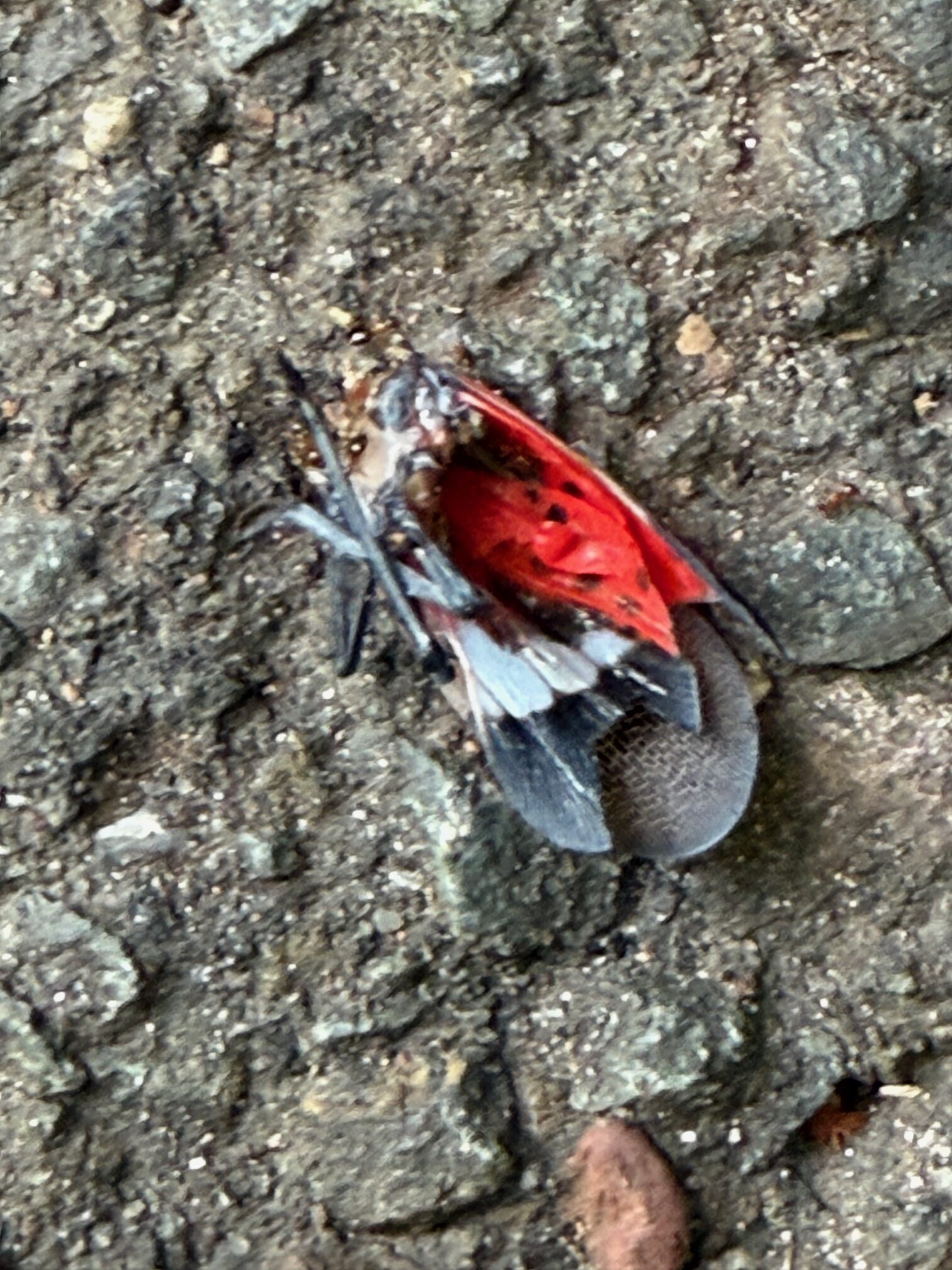
Spotted Lanternfly is a large planthopper insect with four life stages. Full grown, it is colorful, even pretty…with dark grey spotted wings that when opened have showy crimson red and white underneath. Behind their beauty is an ugly truth. They are invasive, with the ability to wreak havoc on all sorts of trees and crops across the country. Think of them as a giant aphid. FORTY SEVEN forest trees are in danger from these bugs. SEVENTY species of plants are fed on by these creatures.They destroy grape vines (vineyards could be in peril, for example), stone fruits, ornamental plantings, and can decimate vegetable crops. To add insult to injury, they also leave sticky honeydew fungus behind.
While they are not a threat to humans or animals (they can’t bite or sting), the impact these pests can have is bad. While I don’t want to be the “Grim Reaper of Gardening”, we ALL need to be aware of these pests.
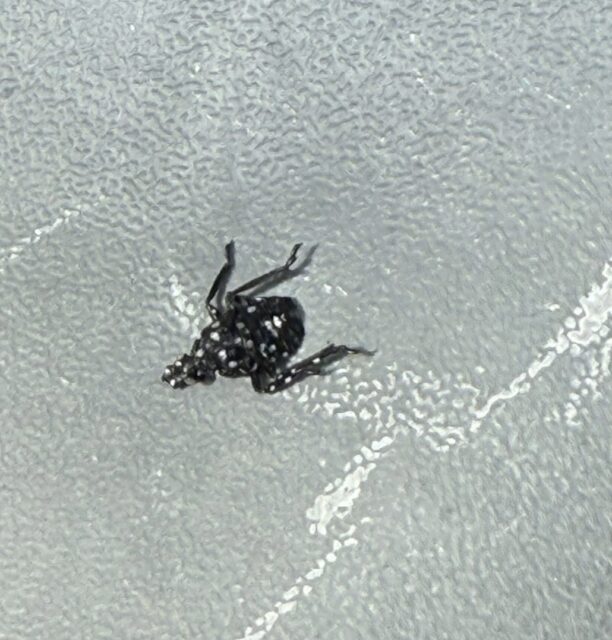
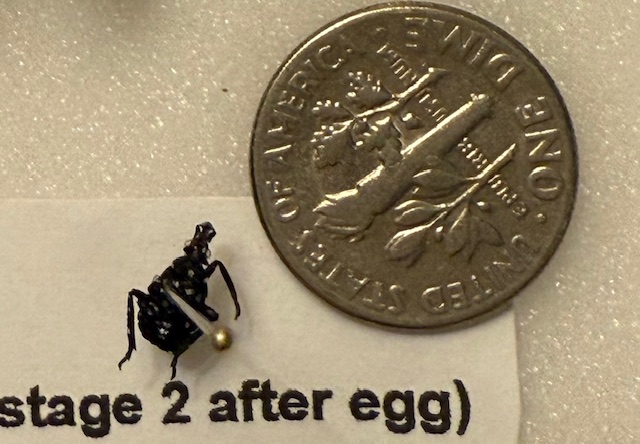
This nymph was a first for me – found in July.
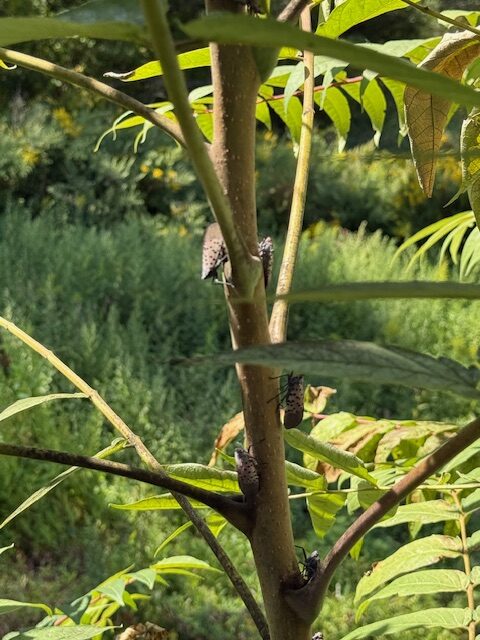
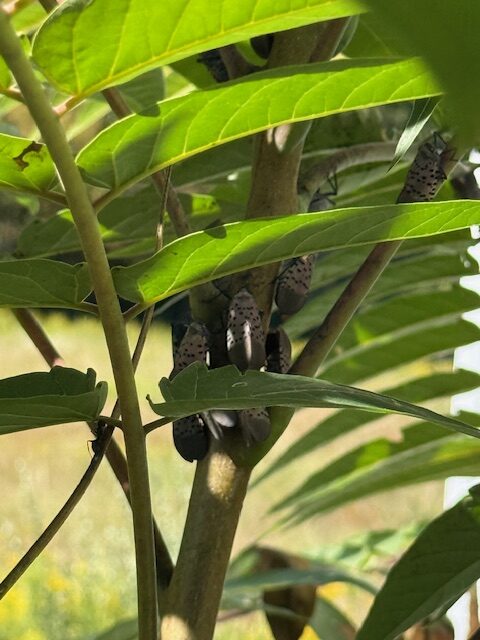
They are great climbers at all stages, including the early nymph stage, found in the spring and early summer, where they resemble a spotty weevil. At the nymph stage, they are black with white spots, eventually later turning red with white spots and black stripes, and then finally becoming the adult winged insect that many people think resembles a moth.
The plant, Tree of Heaven (which was once a very popular landscaping plant, but is now on the invasive list), is their host plant of choice. When I was the guest speaker at a garden club recently, there was a Tree of Heaven, right outside the back door of the meeting place, covered in Spotted Lanternflies.
While the Tree of Heaven is the preferred host plant of choice for these little devils, they do not NEED one to reproduce or lay their eggs, which are laid in masses. Spotted Lanternflies can lay their eggs on just about any hard surface, including trees, large rocks, the sides of buildings, or other hard objects. Removing this invasive tree helps stop the spread. (Difficult for many gardeners to hear, I know, as it is beautiful in the fall when the leaves are scarlet red).
What can you do if YOU see them? With voracious appetites and compound eyes that see well and behind, they don’t fly well but can hop far and fast. They can evade swatting like when a human swats a housefly. Squash, squash, squash, crush, or scrape the buggers into hand sanitizer (it kills them). Destroy reachable egg masses (many are going to be too high up to safely get) by using a hard scraper like an old credit card or a paint scraper, scraping into Ziploc bags of alcohol or hand sanitizer and destroying.
Inspect garden tables and chairs, barbeque pits and other hard objects before storing for the winter, to make sure they are free of any egg masses, which also have several stages and can look differently depending on the “age” of the mass. Scrape off any egg masses you find. Unfortunately, using a hose or powerwasher will not do the trick.
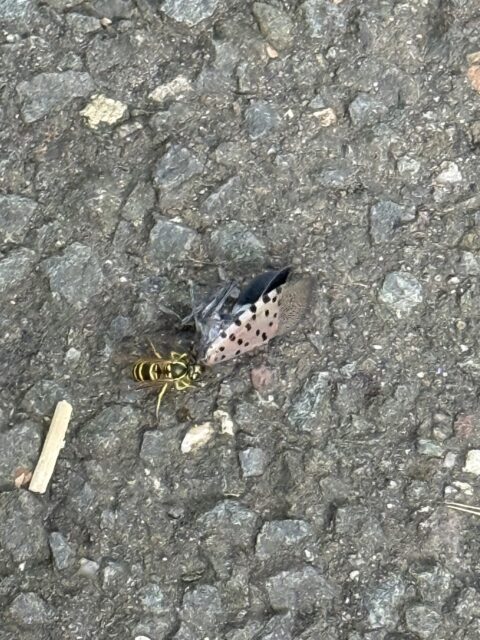
Don’t panic – DO NOT SPRAY everything with insecticides at first sight. Many times, home gardeners overspray insecticides, which kills off the “good” insects, our beneficials, and can create greater numbers of the insects we don’t want. Nature does tend to take care of itself, and migratory birds such as robins have been seen eating them. Beneficial insects such as spiders, the praying mantis, and yellow jackets also feed on them. My daughter and I recently witnessed a yellow jacket devour a live spotted lanternfly in the driveway when we went on a walk.
This yellowjacket attacked this spotted lanternfly right in front of us on a walk.
Twenty minutes later, only the wings were left. Way to go, yellowjacket!
Unfortunately, there is no “one size fits all” means of removal of Spotted Lanternflies recommended at this time. If you do have an extreme infestation, insecticidal soap is an option. Neem oil has also been listed to work on the insects (not the eggs), but follow the directions, don’t overuse it, and spray it in the early morning or late evening, when beneficials are not as active. (Neem is also anti-fungal). Also, avoid “homemade” concoctions. While as a farmgirl, I am all for homemade in almost everything, when it comes to gardening and using any type of spray outside, I only advocate using store bought, and following the directions. You can actually harm the environment, kill your plants, or break the law by making homemade gardening concoctions. Many recipes for “insecticidal soap”, for example, use dish soap as a basis, which has degreasers which can kill your plants.
Check your local DEEP websites, your local Master Gardener extensions, and rely on websites ending in “.edu” for the most up to date and accurate information. For example, researchers at the Penn State extension recently debunked the popular myth that milkweed is toxic to the SLF. While aiding monarchs, milkweed has no effect on Spotted Lanternflies.
Noticing our outdoor surroundings and doing what we can is what we can do for now to stop the spread and reduce their numbers. Don’t let them spoil your fall, just keep your eyes open and be aware that this pest may be around.
Tell me, have YOU seen them in your area? What insects or weeds are YOUR biggest concern right now? Tell me about it, or just say hello by leaving me a comment below!
Posted on September 11, 2025 by Rural Farmgirl Mary Murray
This month we find the days wavering somewhere between Summer and Fall; it’s time for a shift of seasons.
“We are in for a spell of perfect weather now, every day luminous, every night brimmed with stars. Picnics at noon, supper by the applewood fire at night, a walk in the cool moonlight before bed.” -Gladys Taber
“Twenty years from now you will be more disappointed by the things that you didn’t do than by the ones you did do. So throw off the bowlines. Sail away from the safe harbor. Catch the trade winds in your sails. Explore. Dream. Discover.”
~ Mark Twain
Debbie Bosworth
is a certified farmgirl at heart. She’s happily married to her beach bum Yankee husband of 20 years. She went from career gal to being a creative homeschooling mom for two of her biggest blessings and hasn’t looked back since. Debbie left her lifelong home in the high desert of Northern Nevada 10 years ago and washed up on the shore of America’s hometown, Plymouth, MA, where she and her family are now firmly planted. They spend part of each summer in a tiny, off–grid beach cottage named “The Sea Horse.”
“I found a piece of my farmgirl heart when I discovered MaryJanesFarm. Suddenly, everything I loved just made more sense! I enjoy unwinding at the beach, writing, gardening, and turning yard-sale furniture into ‘Painted Ladies’ I’m passionate about living a creative life and encouraging others to ‘make each day their masterpiece.’”
Being a farmgirl is not
about where you live,
but how you live.
Rebekah Teal
is a “MaryJane Farmgirl” who lives in a large metropolitan area. She is a lawyer who has worked in both criminal defense and prosecution. She has been a judge, a business woman and a stay-at-home mom. In addition to her law degree, she has a Masters of Theological Studies.
“Mustering up the courage to do the things you dream about,” she says, “is the essence of being a MaryJane Farmgirl.” Learning to live more organically and closer to nature is Rebekah’s current pursuit. She finds strength and encouragement through MaryJane’s writings, life, and products. And MaryJane’s Farmgirl Connection provides her a wealth of knowledge from true-blue farmgirls.
“Keep close to Nature’s heart … and break clear away once in awhile to climb a mountain or spend a week in the woods, to wash your spirit clean.”
~ John Muir
Cathi Belcher
an old-fashioned farmgirl with a pioneer spirit, lives in the White Mountains of New Hampshire. As a “lifelong learner” in the “Live-Free-or-Die” state, she fiercely values self-reliance, independence, freedom, and fresh mountain air. Married to her childhood sweetheart of 40+ years (a few of them “uphill climbs”), she’s had plenty of time to reinvent herself. From museum curator, restaurant owner, homeschool mom/conference speaker, to post-and-beam house builder and entrepreneur, she’s also a multi-media artist, with an obsession for off-grid living and alternative housing. Cathi owns and operates a 32-room mountain lodge. Her specialty has evolved to include “hermit hospitality” at her rustic cabin in the mountains, where she offers weekend workshops of special interest to women.
“Mountains speak to my soul, and farming is an important part of my heritage. I want to pass on my love of these things to others through my writing. Living in the mountains has its own particular challenges, but I delight in turning them into opportunities from which we can all learn and grow.”
“Wherever you go, no matter the weather, always bring your own sunshine.”
~ Anthony J. D’Angelo
Dori Troutman
Dori Troutman is the daughter of second generation cattle ranchers in New Mexico. She grew up working and playing on the ranch that her grandparents homesteaded in 1928. That ranch, with the old adobe home, is still in the family today. Dori and her husband always yearned for a ranch of their own. That dream came true when they retired to the beautiful green rolling hills of Tennessee. Truly a cattleman’s paradise!
Dori loves all things farmgirl and actually has known no other life but that. She loves to cook, craft, garden, and help with any and all things on their cattle farm.
Wyoming cattle rancher and outpost writer (rider), shares the “view from her saddle.” Shery is a leather and lace cowgirl-farmgirl who’s been horse-crazy all of her life. Her other interests include “junktiques,” arts and crafts, glamping, collecting antique china, and cultivating mirth.
Mary Murray
describes herself as a goat charmer, chicken whisperer, bee maven, and farmers’ market baker renovating an 1864 farmhouse on an Ohio farm. With a degree in Design, Mary says small-town auctions and country road barn sales "always make my heart skip a beat thinking about what I could create or design out of what I’ve seen.”
Rooted in the countryside, she likes simple things and old ways … gardening, preserving the harvest, cooking, baking, and all things home. While you might find her selling baked goods from the farm’s milkhouse, teaching herself to play the fiddle, or sprucing up a vintage camper named Maizy, you will always find her in an apron!
Mary says, “I’m happiest with the simple country pleasures … an old farmhouse, too many animals, a crackling fire, books to read, and the sound of laughter … these make life just perfect.”
is a budding rural farmgirl living in Palmer, the agricultural seat of Alaska. Alex is a graduate student at Alaska Pacific University pursuing an M.S. in Outdoor and Environmental Education. She lives and works on the university’s 700 acre environmental education center, Spring Creek Farm. When Alex has time outside of school, she loves to rock climb, repurpose found objects, cross-country ski on the hay fields, travel, practice yoga, and cook with new-fangled ingredients.
Alex grew up near the Twin Cities and went to college in Madison, Wisconsin—both places where perfectly painted barns and rolling green farmland are just a short drive away. After college, she taught at a rural middle school in South Korea where she biked past verdant rice paddies and old women selling home-grown produce from sidewalk stoops. She was introduced to MaryJanesFarm after returning, and found in it what she’d been searching for—a group of incredible women living their lives in ways that benefit their families, their communities, and the greater environment. What an amazing group of farmgirls to be a part of!
Libbie’s a small town farmgirl who lives in the high-desert Sevier Valley of Central Utah on a 140-year-old farm with her husband and two darling little farmboys—as well as 30 ewes; 60 new little lambs; a handful of rams; a lovely milk cow, Evelynn; an old horse, Doc; two dogs; a bunch o’ chickens; and two kitties.
René Groom
Previous Rural Farmgirl, April 2009 – May 2010
René lives in Washington state’s wine country. She grew up in the dry-land wheat fields of E. Washington, where learning to drive the family truck and tractors, and “snipe hunting,” were rites of passage. She has dirt under her nails and in her veins. In true farmgirl fashion, there is no place on Earth she would rather be than on the farm.
Farmgirl spirit can take root anywhere—dirt or no dirt.
Nicole Christensen
Suburban Farmgirl Nicole Christensen calls herself a “vintage enthusiast”. Born and raised in Texas, she has lived most of her life in the picturesque New England suburbs of Connecticut, just a stone’s throw from New York State. An Advanced Master Gardener, she has gardened since childhood, in several states and across numerous planting zones. In addition, she teaches knitting classes, loves to preserve, and raises backyard chickens.
Married over thirty years to her Danish-born sweetheart, Nicole has worked in various fields, been a world-traveler, an entrepreneur and a homemaker, but considers being mom to her now-adult daughter her greatest accomplishment. Loving all things creative, Nicole considers her life’s motto to be “Bloom where you are planted”.
Previous Suburban Farmgirl, October 2009 – October 2010
Paula is a mom of four and a journalist who’s partial to writing about common sense and women’s interests. She’s lived in five great farm states (Michigan, Iowa, New York, Tennessee, and now North Carolina), though never on a farm. She’s nevertheless inordinately fond of heirloom tomatoes, fine stitching, early mornings, and making pies. And sock monkeys.







Weekly Blogs and Recipes