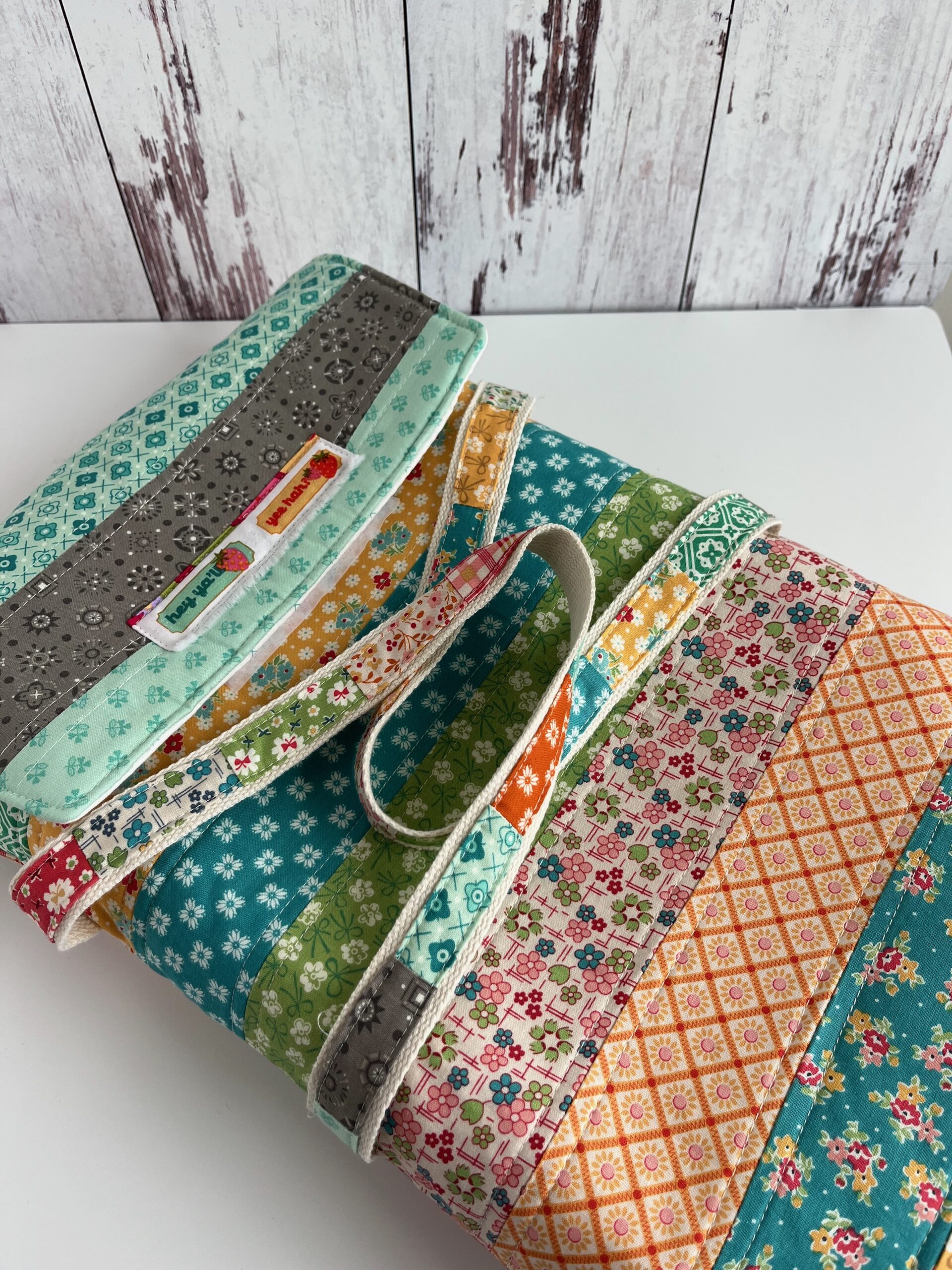
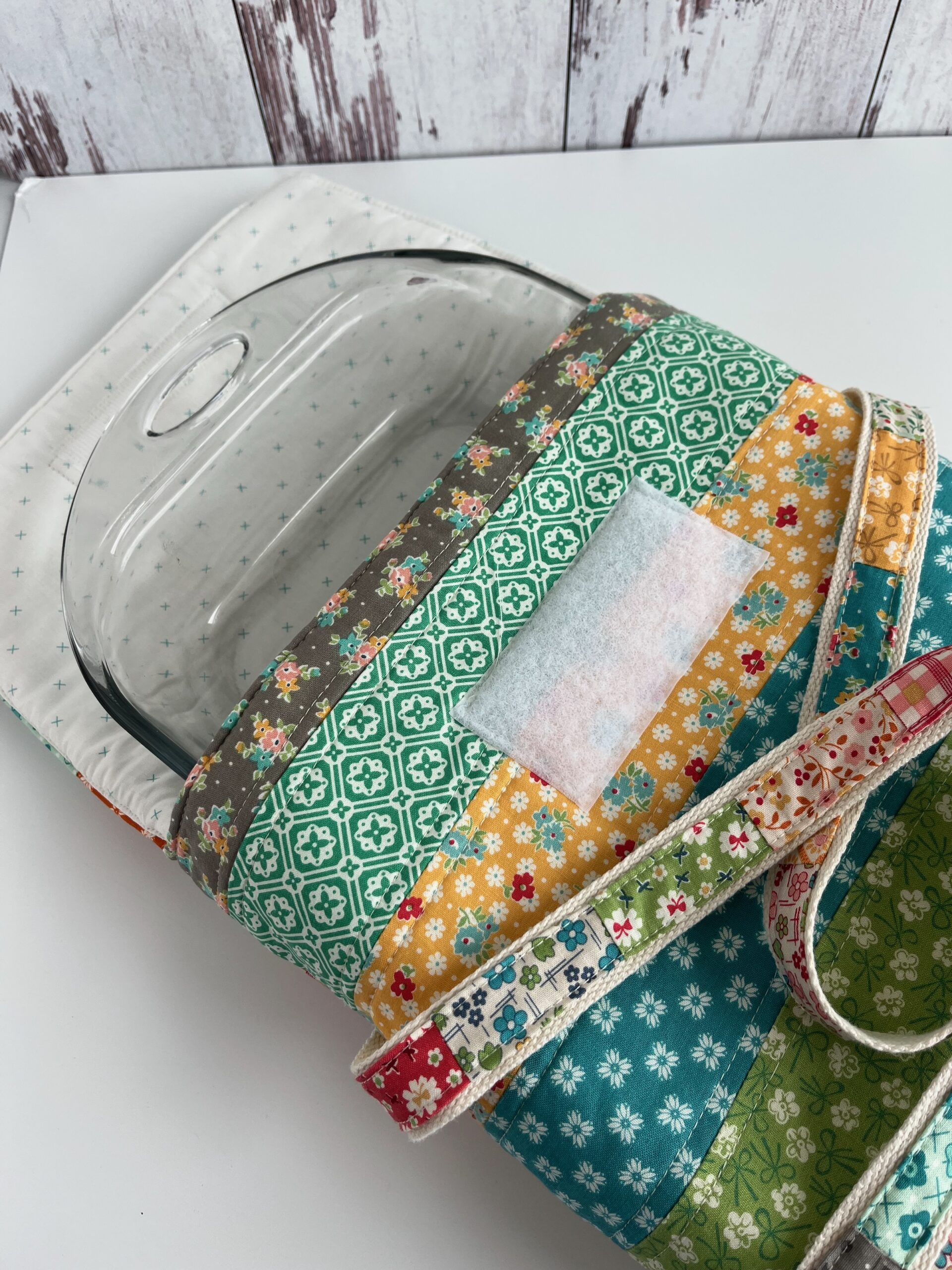
I’ve been working on a design to sew a darling fabric casserole carrier… something like a purse to carry your casserole to a potluck! And I’m ready to share it so you can make it too!
.
.
I’ve written a detailed pattern for you to follow and you can click the link here to print it, or save it to your computer to use later!
.
.
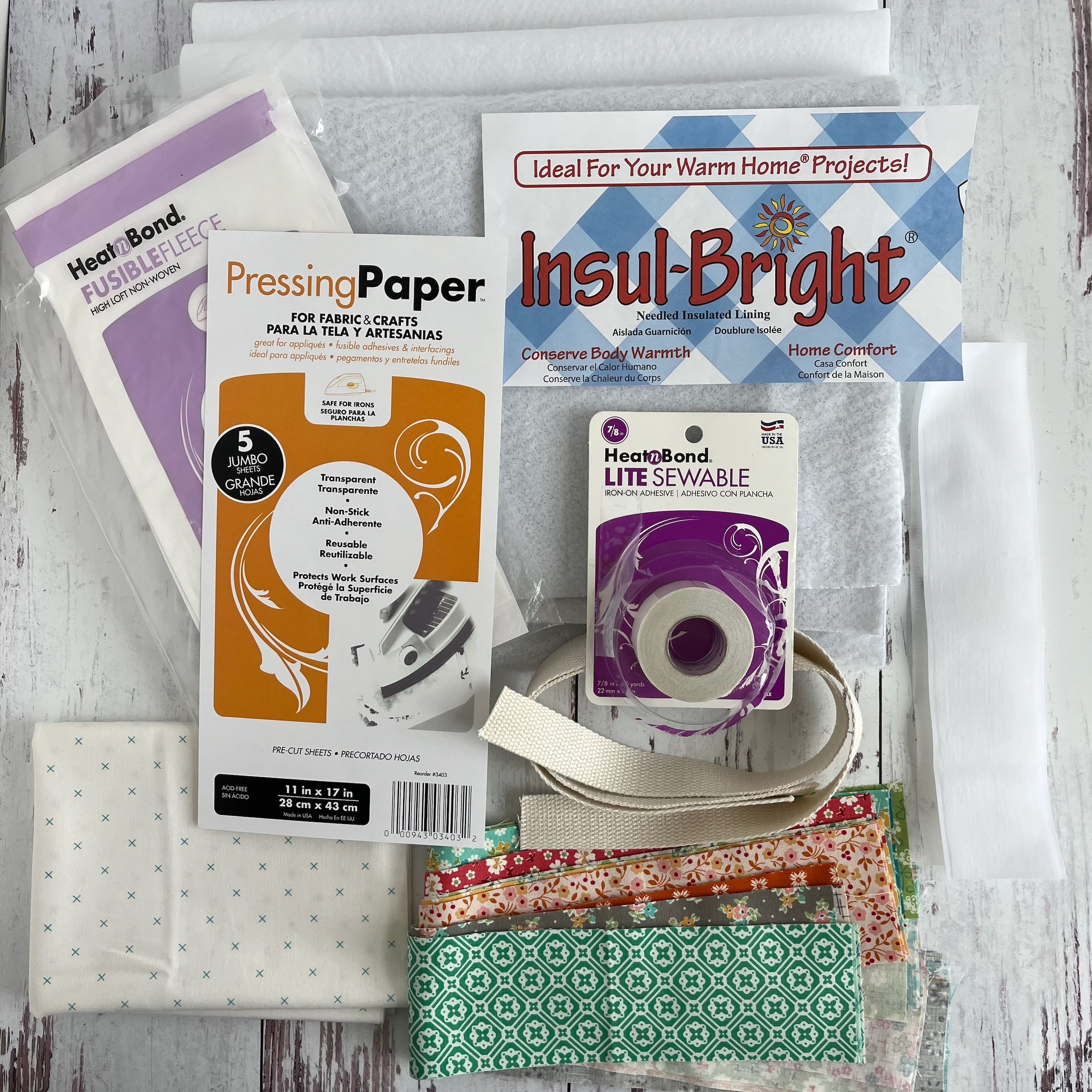
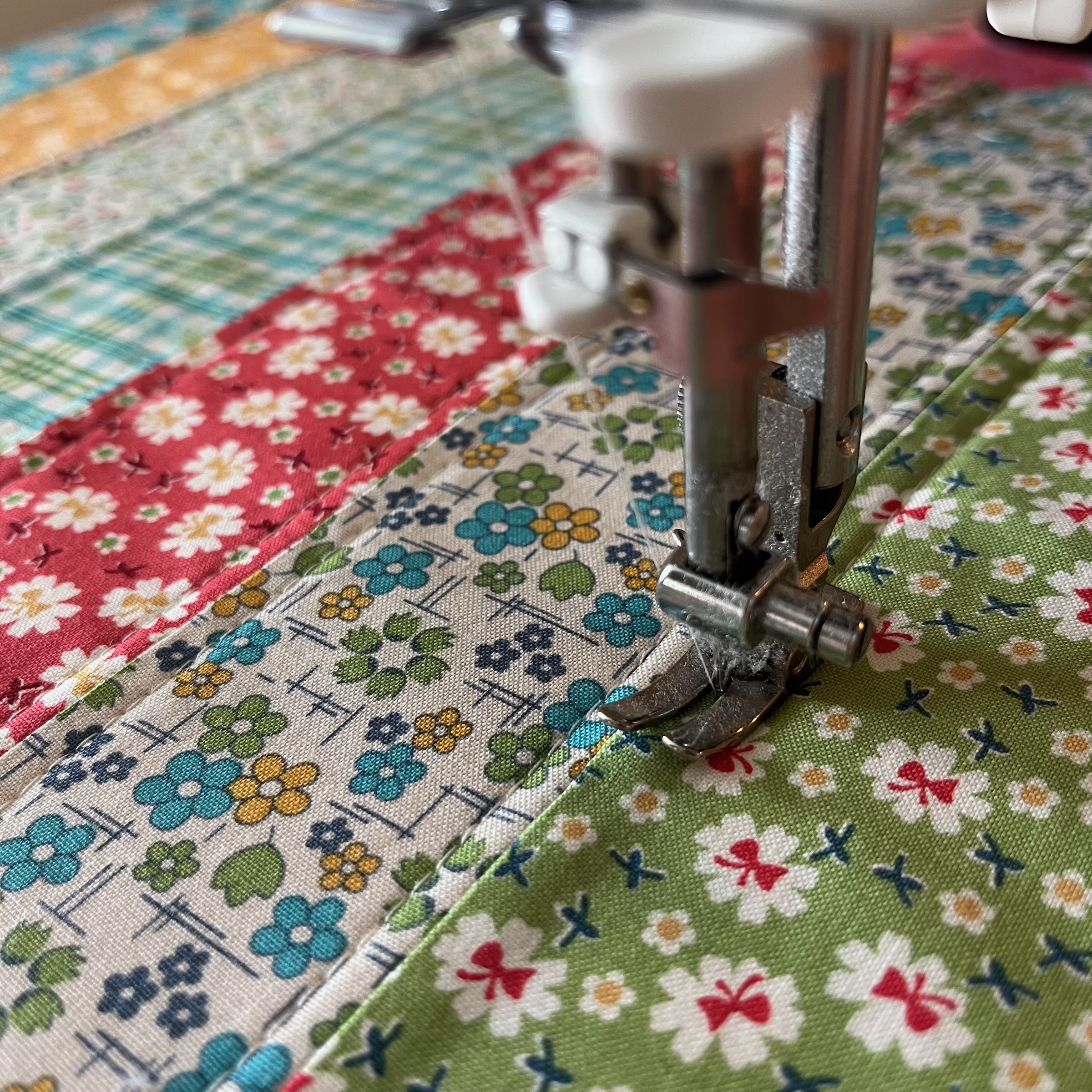
I used a really fun fabric that is bright, colorful and felt very much like my kitchen! This fabric came in a jelly roll – 2.5 inch strips and it really made it perfect for this project. You can also cut 2.5 inch strips from any fabric that you love. I also did a quick machine quilting along each side of the seams; its a great way to give a project like this some dimension!
.
.
.
The carrier uses velcro to keep it closed. And cotton webbing for the strap handles. I chose to use some of my left over fabric strips to sew onto the webbing… my pattern shares a really quick and fun way to attach it.
.
.
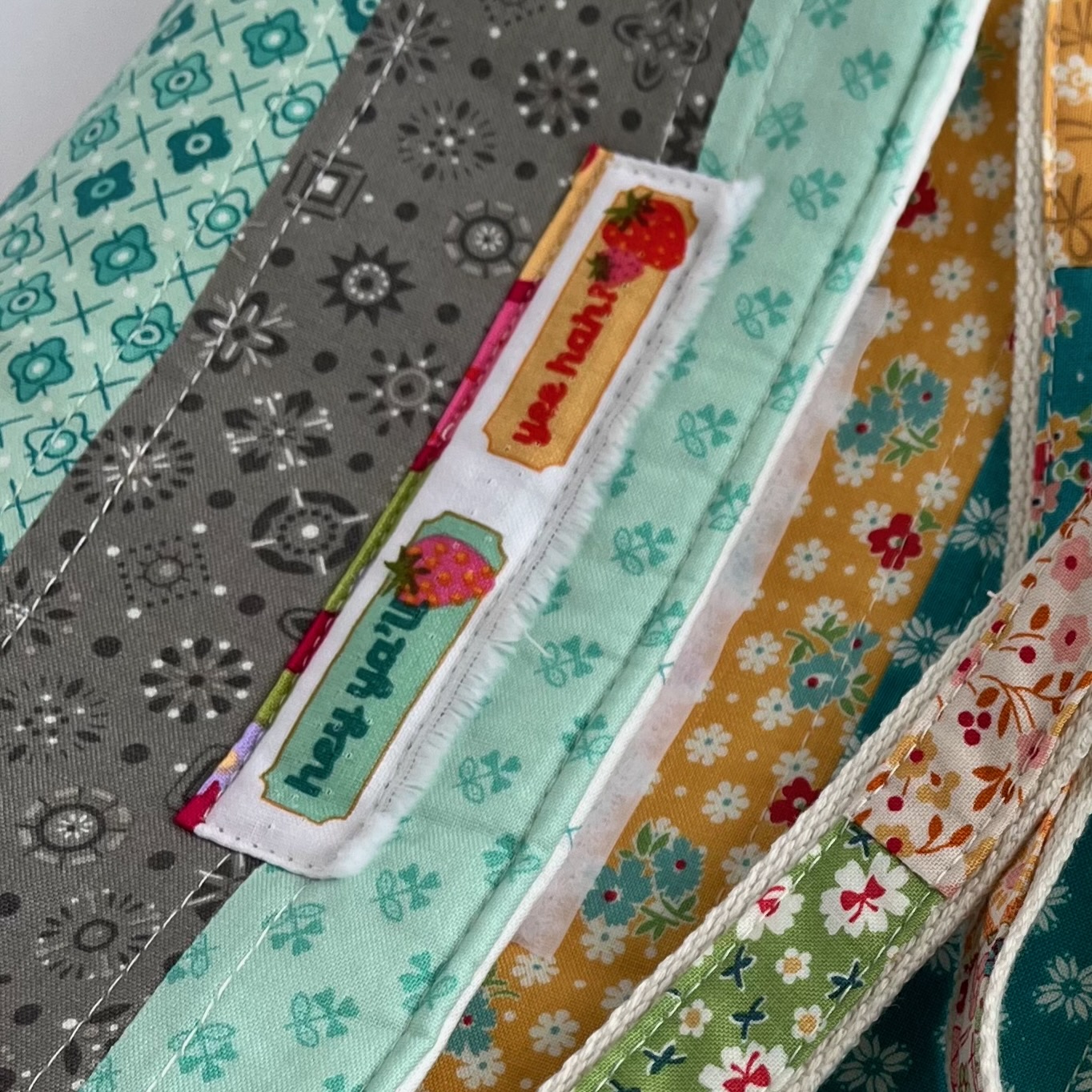
I “hid” my velcro stitching on the outside of the carrier by sewing a cute little fabric patch from a fabric selvedge I had saved!
.
I’m looking forward to the next potluck I go to… so I can carry my casserole dish in Farmgirl Style! I hope you’ll make one for yourself! Be sure to let me know if you do!
March Greetings, Farmgirl Readers! Though we are almost halfway through the month, here in New England, the first quarter of 2026 has had the longest, harshest winter in decades! 2026 also marks a very important anniversary milestone for our country, so what better time to take an indoor class on Colonial sewing?
We’ve had more snow, more ice, and more extremely cold temperatures than I can remember in the last 30 years that I have lived in New England. When not going to work or school, everyone just seems to be “hunkering down” until winter passes.
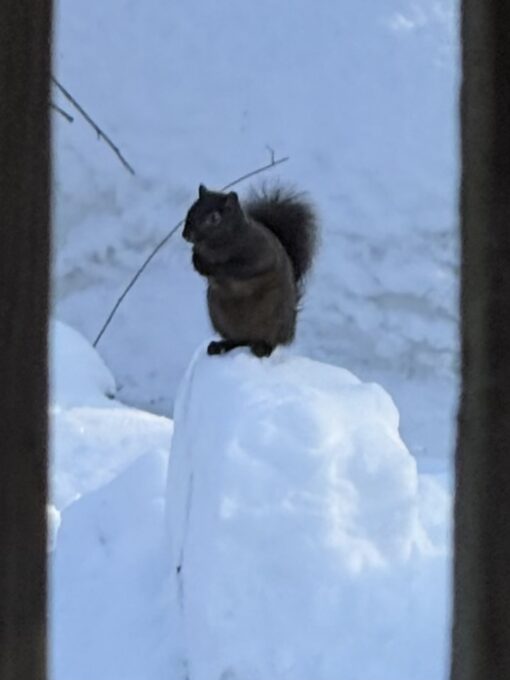
Winter fatigue is setting in! Even the wildlife is thinking “When is this winter weather going away?”
While I enjoy winter, the last few weeks, I have been feeling like a hibernating bear! It’s the perfect time to have something to look forward to and learn something new. That’s one reason I was so excited when I saw my hometown’s Historical Society offer a three-part, hands-on workshop on how to make 18th century garments, in honor of our country’s 250th anniversary. All year long, I teach knitting and gardening classes, so taking a class as a participant is very exciting. I also love learning about history, especially American history. I could not wait!
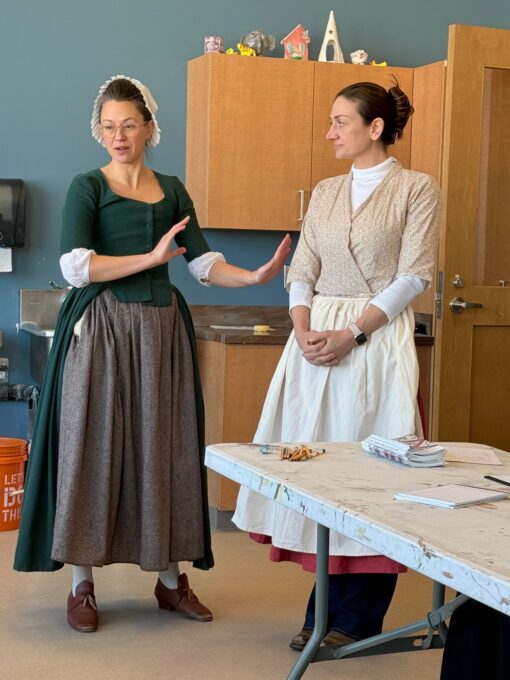
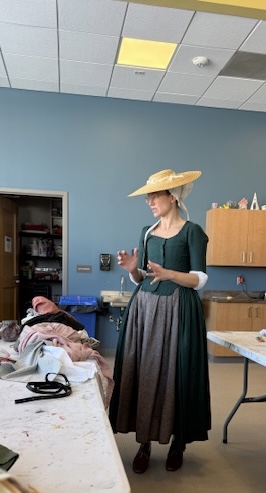
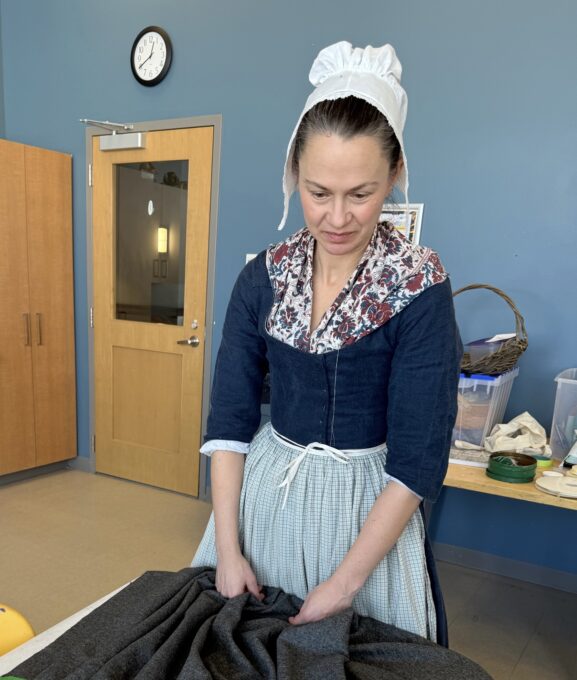
The workshop is led by Melissa Houston, Director of Education at the Greenwich Historical Society, (and historical sewing instructor) who was once a high school classroom history teacher and also previously served on the Board of the Newtown Historical Society. Her historical knowledge and expertise is really amazing! While she has done reenacting, Melissa is a costume interpreter. Melissa explained the difference between a historical reenactor and a costume interpreter: “A reenactor perfectly portrays a moment in time, while a costume interpreter uses clothing as a teaching tool.” Melissa’s attention to detail and skill at being historically accurate with her clothing is incredible, so when she walked in the door, it was like seeing history come to life!
At the first installment, we learned that we would be making a colonial-style apron, petticoat, and bed gown, all sewn by hand. I sew quite a bit with my sewing machines. I also do embroidery, repair toys, dolls and clothing all by hand, but I have never constructed an entire, large garment with only hand sewing. I am not going to be a docent or do reenacting, but I do love history and am so grateful to have this experience, especially this year, with our country’s 250th birthday!
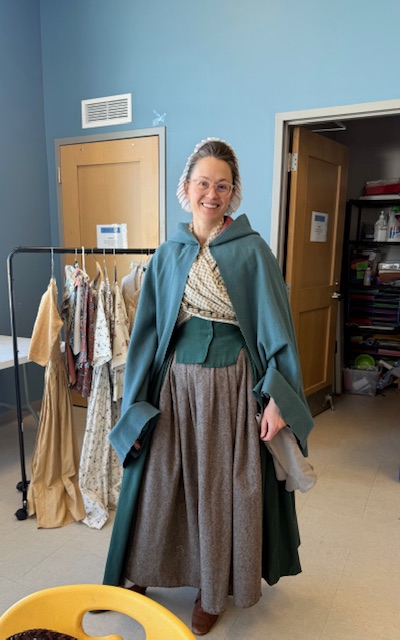
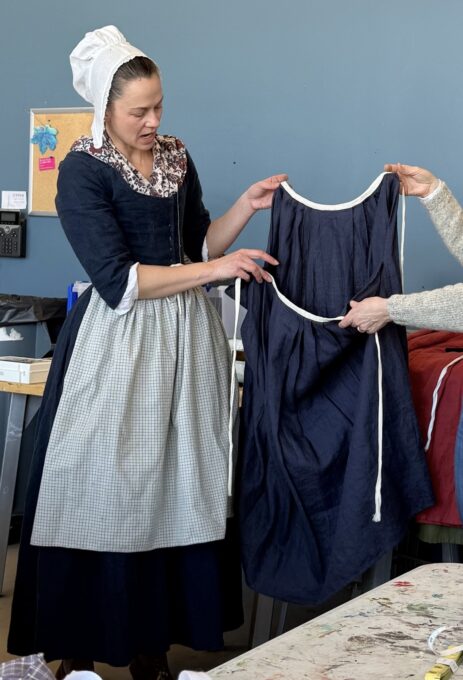
As Melissa teaches us about the fashions of the time and fabrics, Abby from the Newtown Historical Society models the three pieces participants will learn to make.
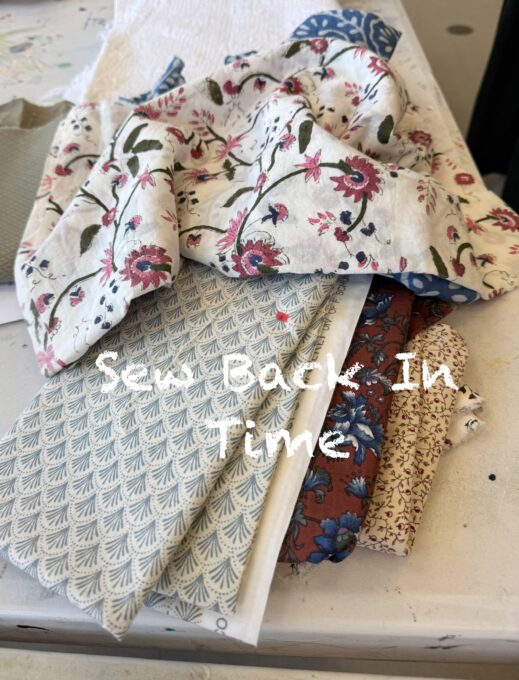
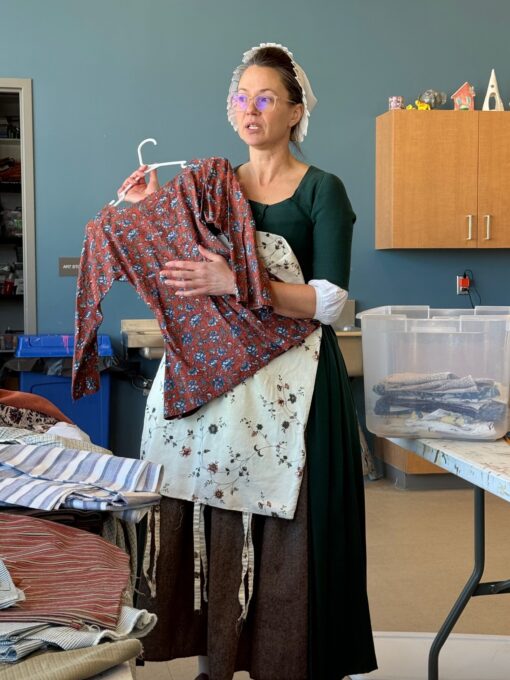
We learned what different fabrics would have been used for clothing during around the year 1776. I was surprised by much of what we learned, such as how many layers women wore at one time, thinking that I would have burned up under all of the clothing! However, fabrics were all made of natural fibers, so everything worn back in Colonial America was breathable.
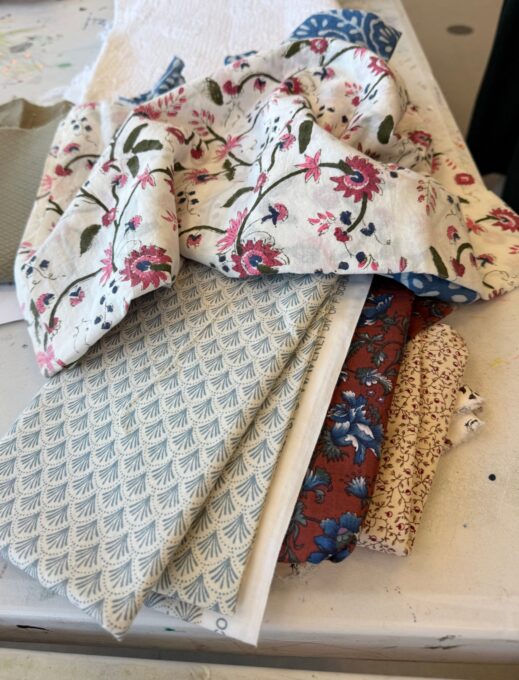
Fabrics such as cotton, wool and silk were used. Linen was also popular in the 18th century, in part because it was strong, standing up to tough laundering practices, such as boiling. Stripes, checks and vining prints could be seen on fabrics, but stripes would be symmetrical and on both sides, like ticking. Nothing was made on a machine, like the mass produced fabrics we have now, but instead was woven or stamped. Shell-type prints were found in the late 1770s, while dots would have been found around 1794.
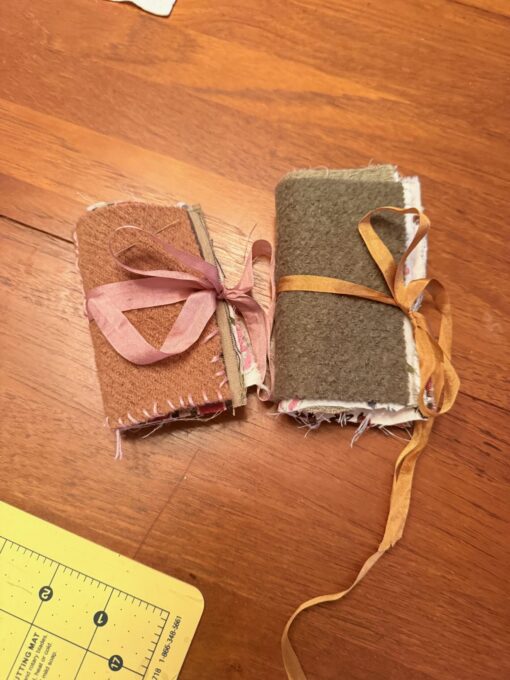
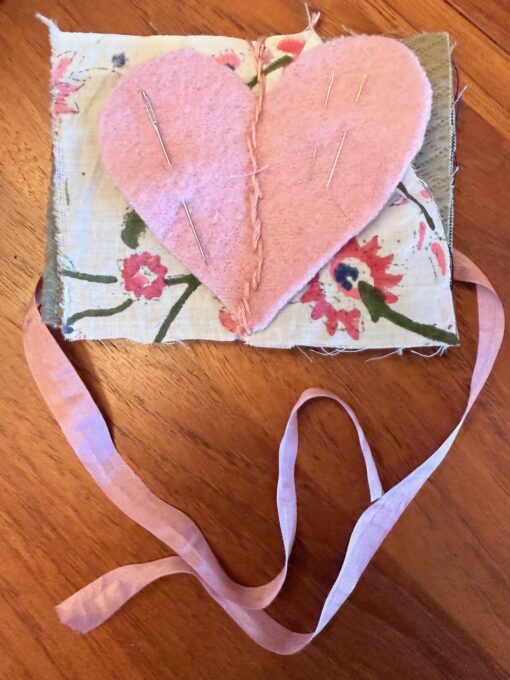
Melissa gave us all samples of different types of fabrics so we could practice our stitches by making a “needle book”, with silk ribbon ties. My friend Charlene and I finished ours together over coffee one cold afternoon, and they both came out so cute (and useful)!
Aprons were long, tying around the waist. Women wore them to do tasks such as gardening. To start, we measured the fabric from our belly button to our ankle bone for length. I was so surprised that they did not go to the floor. It’s a common misconception that women did not show their ankles in Colonial times! In fact, skirt lengths were made so that women could go upstairs without “touching” the skirt to pull it up and avoid tripping.
Starting my apron. The fabric I chose is vintage, purchased from a local fabric store that carries vintage as well as new fabrics!
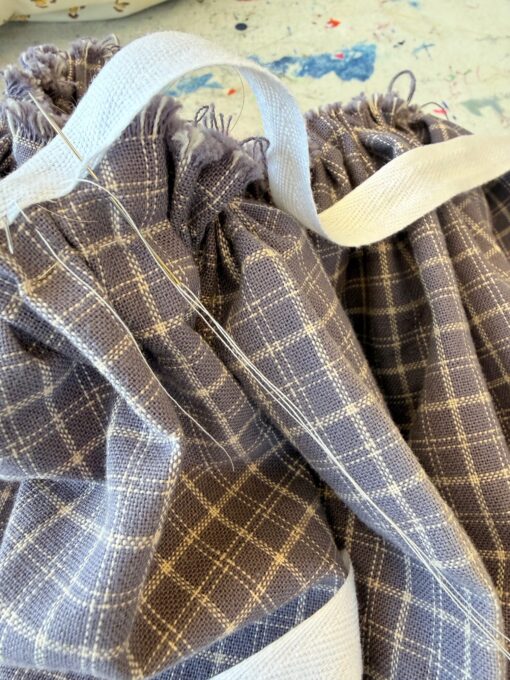
I am working on my apron now. We first made a long, running stitch and gathered the fabric. Next, long ties are hand sewn to the fabric at the top using the overcast stitch. I can’t wait to show you all when my pieces are all completed! Stay tuned!
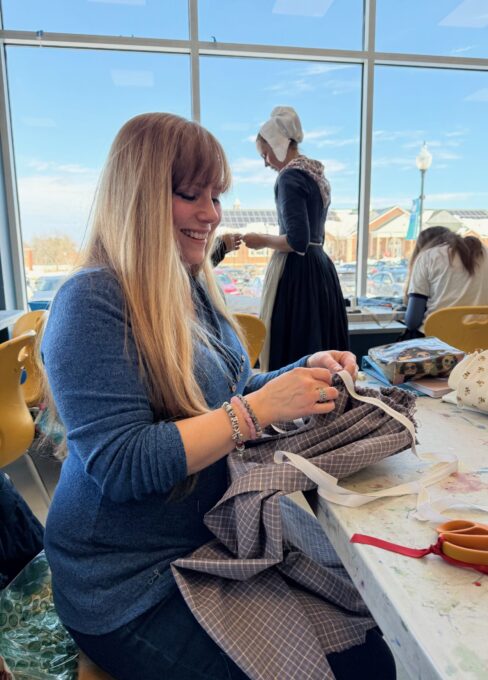
I am happily sewing on my apron, attaching the ties. I’m currently finishing it at home.
Next, we will be making our petticoats and finally, our bedjackets. Colonial petticoats are not like the puffy, crinoline-type of the 1950’s that first come to my mind when I think “petticoat”, but rather more like two aprons, four inches longer and sewn together.
Melissa shows us the construction of the petticoat, with pleats on both sides, on the outside in front, and on the inside in back.
Petticoats were pleated, not gathered, with a box pleat in the middle. Petticoats tied with two ties, with eight inch openings on each side, so women could access their “pockets”, which were essentially little “bags” tied to the sides. Petticoats would have been made from heavier fabrics such as heavy cotton or wool. Melissa told us, “In the 1700’s the shape of the clothing did not show if you were rich or poor, it was the fabric.” You would not mix informal and formal clothing – no homespun fabric worn with fancy cotton, and fabric would match, such as wool with wool. The amount of clothing someone had was based on wealth; the average woman had five to thirteen gowns. Older women would layer their scarves to show their wealth.
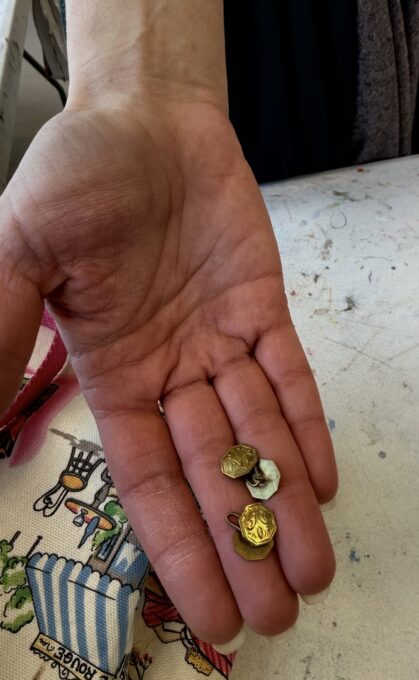
Sunscreen and bug spray did not exist, so skin would be totally covered. Chores during the colonial times were dictated by the weather, so sewing was done during the winter, but it was mostly small items that were made at home. For bedgowns, petticoats and aprons, you did not need stays, but if you wore a gown, you needed stays. “Stays” do not hurt like a corset. Tailors made the stays, seamstresses sewed gowns. A “shift” was a long-sleeved linen dress that could go under everything – closed with “sleeve buttons”. There was no elastic in those days!
An example of colonial “sleeve buttons” that would have been used on the sleeves of a linen shift.
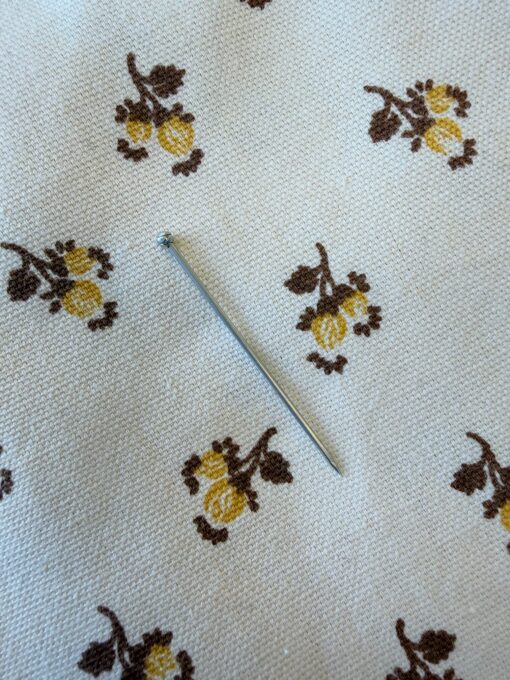
There were also no buttons on the front of the women’ s clothing; instead women closed their garments with pins. This also helped to adjust the size of the clothing during and after pregnancy.
An example of the pins that would have been used to close their clothing in front, similar to a modern “straight pin”, with a head at one end.
If something no longer fit, you would sell the finished piece to buy more fabric (or hand it down). There was an enormous used clothing market in 1776!
Can you just imagine New England women in the 18th century, sitting by a crackling fire on a snowy, cold day, using their beeswax, needle and thread, hand sewing a pretty apron to wear for spring gardening! I am so inspired by and really looking forward to attending the third installment of classes!
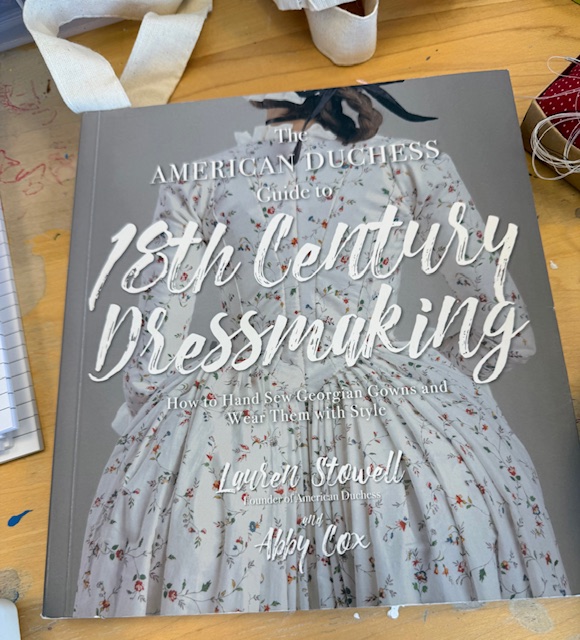
If this sparks your interest, Melissa recommends this book for further reading.
What do you think – would you have enjoyed wearing the fashion of 1776 as a colonist? Leave me a comment below, and let me know that you stopped by!
*A special thanks to Melissa Houston, Director of Education, Greenwich Historical Society and to the Newtown Historical Society! Remember to check out your local Historical Society for great events, museums and historical preservation!
March, known for her flirty moments of sunshine and birdsong one day, and then the threat of snow and ice the next. This morning I needed to slip on my winter coat and boots before going outdoors, as Mother Nature was quite happy to send a little sleet and dense fog my direction. Oh well, no matter; off with the coat and boots, it’s time for a cup of tea…the simple things of life, indeed.
Today my mind is not on the threat of frosty weather, but on the promise that’s in the air: the promise of violets & daffodils, pink apple blossoms, and the earthy-scent of freshly-plowed fields. I’ve heard it said that finding promise in simple pleasures is available for anyone willing to look…I whole heartedly agree.
“Twenty years from now you will be more disappointed by the things that you didn’t do than by the ones you did do. So throw off the bowlines. Sail away from the safe harbor. Catch the trade winds in your sails. Explore. Dream. Discover.”
~ Mark Twain
Debbie Bosworth
is a certified farmgirl at heart. She’s happily married to her beach bum Yankee husband of 20 years. She went from career gal to being a creative homeschooling mom for two of her biggest blessings and hasn’t looked back since. Debbie left her lifelong home in the high desert of Northern Nevada 10 years ago and washed up on the shore of America’s hometown, Plymouth, MA, where she and her family are now firmly planted. They spend part of each summer in a tiny, off–grid beach cottage named “The Sea Horse.”
“I found a piece of my farmgirl heart when I discovered MaryJanesFarm. Suddenly, everything I loved just made more sense! I enjoy unwinding at the beach, writing, gardening, and turning yard-sale furniture into ‘Painted Ladies’ I’m passionate about living a creative life and encouraging others to ‘make each day their masterpiece.’”
Being a farmgirl is not
about where you live,
but how you live.
Rebekah Teal
is a “MaryJane Farmgirl” who lives in a large metropolitan area. She is a lawyer who has worked in both criminal defense and prosecution. She has been a judge, a business woman and a stay-at-home mom. In addition to her law degree, she has a Masters of Theological Studies.
“Mustering up the courage to do the things you dream about,” she says, “is the essence of being a MaryJane Farmgirl.” Learning to live more organically and closer to nature is Rebekah’s current pursuit. She finds strength and encouragement through MaryJane’s writings, life, and products. And MaryJane’s Farmgirl Connection provides her a wealth of knowledge from true-blue farmgirls.
“Keep close to Nature’s heart … and break clear away once in awhile to climb a mountain or spend a week in the woods, to wash your spirit clean.”
~ John Muir
Cathi Belcher
an old-fashioned farmgirl with a pioneer spirit, lives in the White Mountains of New Hampshire. As a “lifelong learner” in the “Live-Free-or-Die” state, she fiercely values self-reliance, independence, freedom, and fresh mountain air. Married to her childhood sweetheart of 40+ years (a few of them “uphill climbs”), she’s had plenty of time to reinvent herself. From museum curator, restaurant owner, homeschool mom/conference speaker, to post-and-beam house builder and entrepreneur, she’s also a multi-media artist, with an obsession for off-grid living and alternative housing. Cathi owns and operates a 32-room mountain lodge. Her specialty has evolved to include “hermit hospitality” at her rustic cabin in the mountains, where she offers weekend workshops of special interest to women.
“Mountains speak to my soul, and farming is an important part of my heritage. I want to pass on my love of these things to others through my writing. Living in the mountains has its own particular challenges, but I delight in turning them into opportunities from which we can all learn and grow.”
“Wherever you go, no matter the weather, always bring your own sunshine.”
~ Anthony J. D’Angelo
Dori Troutman
Dori Troutman is the daughter of second generation cattle ranchers in New Mexico. She grew up working and playing on the ranch that her grandparents homesteaded in 1928. That ranch, with the old adobe home, is still in the family today. Dori and her husband always yearned for a ranch of their own. That dream came true when they retired to the beautiful green rolling hills of Tennessee. Truly a cattleman’s paradise!
Dori loves all things farmgirl and actually has known no other life but that. She loves to cook, craft, garden, and help with any and all things on their cattle farm.
Wyoming cattle rancher and outpost writer (rider), shares the “view from her saddle.” Shery is a leather and lace cowgirl-farmgirl who’s been horse-crazy all of her life. Her other interests include “junktiques,” arts and crafts, glamping, collecting antique china, and cultivating mirth.
Mary Murray
describes herself as a goat charmer, chicken whisperer, bee maven, and farmers’ market baker renovating an 1864 farmhouse on an Ohio farm. With a degree in Design, Mary says small-town auctions and country road barn sales "always make my heart skip a beat thinking about what I could create or design out of what I’ve seen.”
Rooted in the countryside, she likes simple things and old ways … gardening, preserving the harvest, cooking, baking, and all things home. While you might find her selling baked goods from the farm’s milkhouse, teaching herself to play the fiddle, or sprucing up a vintage camper named Maizy, you will always find her in an apron!
Mary says, “I’m happiest with the simple country pleasures … an old farmhouse, too many animals, a crackling fire, books to read, and the sound of laughter … these make life just perfect.”
is a budding rural farmgirl living in Palmer, the agricultural seat of Alaska. Alex is a graduate student at Alaska Pacific University pursuing an M.S. in Outdoor and Environmental Education. She lives and works on the university’s 700 acre environmental education center, Spring Creek Farm. When Alex has time outside of school, she loves to rock climb, repurpose found objects, cross-country ski on the hay fields, travel, practice yoga, and cook with new-fangled ingredients.
Alex grew up near the Twin Cities and went to college in Madison, Wisconsin—both places where perfectly painted barns and rolling green farmland are just a short drive away. After college, she taught at a rural middle school in South Korea where she biked past verdant rice paddies and old women selling home-grown produce from sidewalk stoops. She was introduced to MaryJanesFarm after returning, and found in it what she’d been searching for—a group of incredible women living their lives in ways that benefit their families, their communities, and the greater environment. What an amazing group of farmgirls to be a part of!
Libbie’s a small town farmgirl who lives in the high-desert Sevier Valley of Central Utah on a 140-year-old farm with her husband and two darling little farmboys—as well as 30 ewes; 60 new little lambs; a handful of rams; a lovely milk cow, Evelynn; an old horse, Doc; two dogs; a bunch o’ chickens; and two kitties.
René Groom
Previous Rural Farmgirl, April 2009 – May 2010
René lives in Washington state’s wine country. She grew up in the dry-land wheat fields of E. Washington, where learning to drive the family truck and tractors, and “snipe hunting,” were rites of passage. She has dirt under her nails and in her veins. In true farmgirl fashion, there is no place on Earth she would rather be than on the farm.
Farmgirl spirit can take root anywhere—dirt or no dirt.
Nicole Christensen
Suburban Farmgirl Nicole Christensen calls herself a “vintage enthusiast”. Born and raised in Texas, she has lived most of her life in the picturesque New England suburbs of Connecticut, just a stone’s throw from New York State. An Advanced Master Gardener, she has gardened since childhood, in several states and across numerous planting zones. In addition, she teaches knitting classes, loves to preserve, and raises backyard chickens.
Married over thirty years to her Danish-born sweetheart, Nicole has worked in various fields, been a world-traveler, an entrepreneur and a homemaker, but considers being mom to her now-adult daughter her greatest accomplishment. Loving all things creative, Nicole considers her life’s motto to be “Bloom where you are planted”.
Previous Suburban Farmgirl, October 2009 – October 2010
Paula is a mom of four and a journalist who’s partial to writing about common sense and women’s interests. She’s lived in five great farm states (Michigan, Iowa, New York, Tennessee, and now North Carolina), though never on a farm. She’s nevertheless inordinately fond of heirloom tomatoes, fine stitching, early mornings, and making pies. And sock monkeys.




Weekly Blogs and Recipes