

March Greetings, Farmgirl Readers! Though we are almost halfway through the month, here in New England, the first quarter of 2026 has had the longest, harshest winter in decades! 2026 also marks a very important anniversary milestone for our country, so what better time to take an indoor class on Colonial sewing?
We’ve had more snow, more ice, and more extremely cold temperatures than I can remember in the last 30 years that I have lived in New England. When not going to work or school, everyone just seems to be “hunkering down” until winter passes.

While I enjoy winter, the last few weeks, I have been feeling like a hibernating bear! It’s the perfect time to have something to look forward to and learn something new. That’s one reason I was so excited when I saw my hometown’s Historical Society offer a three-part, hands-on workshop on how to make 18th century garments, in honor of our country’s 250th anniversary. All year long, I teach knitting and gardening classes, so taking a class as a participant is very exciting. I also love learning about history, especially American history. I could not wait!
The workshop is led by Melissa Houston, Director of Education at the Greenwich Historical Society, (and historical sewing instructor) who was once a high school classroom history teacher and also previously served on the Board of the Newtown Historical Society. Her historical knowledge and expertise is really amazing! While she has done reenacting, Melissa is a costume interpreter. Melissa explained the difference between a historical reenactor and a costume interpreter: “A reenactor perfectly portrays a moment in time, while a costume interpreter uses clothing as a teaching tool.” Melissa’s attention to detail and skill at being historically accurate with her clothing is incredible, so when she walked in the door, it was like seeing history come to life!

At the first installment, we learned that we would be making a colonial-style apron, petticoat, and bed gown, all sewn by hand. I sew quite a bit with my sewing machines. I also do embroidery, repair toys, dolls and clothing all by hand, but I have never constructed an entire, large garment with only hand sewing. I am not going to be a docent or do reenacting, but I do love history and am so grateful to have this experience, especially this year, with our country’s 250th birthday!

We learned what different fabrics would have been used for clothing during around the year 1776. I was surprised by much of what we learned, such as how many layers women wore at one time, thinking that I would have burned up under all of the clothing! However, fabrics were all made of natural fibers, so everything worn back in Colonial America was breathable.

Fabrics such as cotton, wool and silk were used. Linen was also popular in the 18th century, in part because it was strong, standing up to tough laundering practices, such as boiling. Stripes, checks and vining prints could be seen on fabrics, but stripes would be symmetrical and on both sides, like ticking. Nothing was made on a machine, like the mass produced fabrics we have now, but instead was woven or stamped. Shell-type prints were found in the late 1770s, while dots would have been found around 1794.

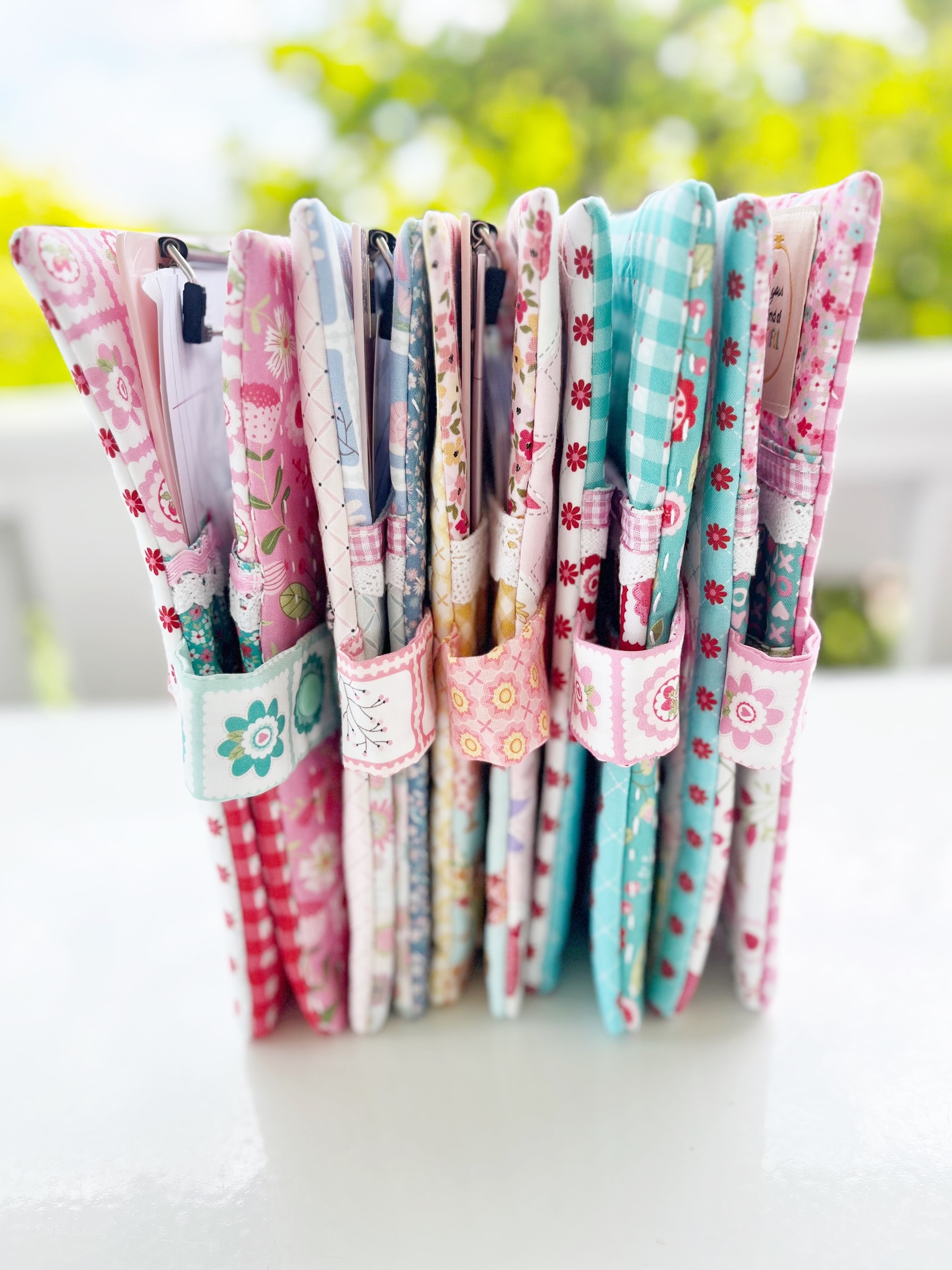
Melissa gave us all samples of different types of fabrics so we could practice our stitches by making a “needle book”, with silk ribbon ties. My friend Charlene and I finished ours together over coffee one cold afternoon, and they both came out so cute (and useful)!


Aprons were long, tying around the waist. Women wore them to do tasks such as gardening. To start, we measured the fabric from our belly button to our ankle bone for length. I was so surprised that they did not go to the floor. It’s a common misconception that women did not show their ankles in Colonial times! In fact, skirt lengths were made so that women could go upstairs without “touching” the skirt to pull it up and avoid tripping.

I am working on my apron now. We first made a long, running stitch and gathered the fabric. Next, long ties are hand sewn to the fabric at the top using the overcast stitch. I can’t wait to show you all when my pieces are all completed! Stay tuned!

Next, we will be making our petticoats and finally, our bedjackets. Colonial petticoats are not like the puffy, crinoline-type of the 1950’s that first come to my mind when I think “petticoat”, but rather more like two aprons, four inches longer and sewn together.

Petticoats were pleated, not gathered, with a box pleat in the middle. Petticoats tied with two ties, with eight inch openings on each side, so women could access their “pockets”, which were essentially little “bags” tied to the sides. Petticoats would have been made from heavier fabrics such as heavy cotton or wool. Melissa told us, “In the 1700’s the shape of the clothing did not show if you were rich or poor, it was the fabric.” You would not mix informal and formal clothing – no homespun fabric worn with fancy cotton, and fabric would match, such as wool with wool. The amount of clothing someone had was based on wealth; the average woman had five to thirteen gowns. Older women would layer their scarves to show their wealth.

Sunscreen and bug spray did not exist, so skin would be totally covered. Chores during the colonial times were dictated by the weather, so sewing was done during the winter, but it was mostly small items that were made at home. For bedgowns, petticoats and aprons, you did not need stays, but if you wore a gown, you needed stays. “Stays” do not hurt like a corset. Tailors made the stays, seamstresses sewed gowns. A “shift” was a long-sleeved linen dress that could go under everything – closed with “sleeve buttons”. There was no elastic in those days!

There were also no buttons on the front of the women’ s clothing; instead women closed their garments with pins. This also helped to adjust the size of the clothing during and after pregnancy.

If something no longer fit, you would sell the finished piece to buy more fabric (or hand it down). There was an enormous used clothing market in 1776!

Can you just imagine New England women in the 18th century, sitting by a crackling fire on a snowy, cold day, using their beeswax, needle and thread, hand sewing a pretty apron to wear for spring gardening! I am so inspired by and really looking forward to attending the third installment of classes!

What do you think – would you have enjoyed wearing the fashion of 1776 as a colonist? Leave me a comment below, and let me know that you stopped by!
*A special thanks to Melissa Houston, Director of Education, Greenwich Historical Society and to the Newtown Historical Society! Remember to check out your local Historical Society for great events, museums and historical preservation!


I do enjoy and have made18th century clothing, but more European style, not so much the simpler colonial wear. I may get this book though, because colonial clothing is great everyday chore wear. I just finished a flannel petticoat that I wear constantly!
Hi Shari, Wow – how cool! I love that! Do you do reenacting, as well, or just enjoy the clothing? The aprons are so useful, and the petticoats are adorable. Do you have a particular area of Europe that you like to make the clothing from? I’d love to hear more. Thank you for reading and commenting! Farmgirl Hugs, Nicole
I do renactments and period dancing. I suppose the 18th century stuff is Parisian mostly. The 16th century stuff is English and Italian. I make Victorian and Edwardian stuff to, just to wear, because we have a Victorian home.
Shari, that is just so cool! Very impressive, and I bet also very fun! Farmgirl Hugs, Nicole
I loved this article. I enjoy hand sewing and learning about the history of life from generations ago. My ancestors immigrated from England and Denmark and helped establish Manhattan, and later migrated west. They were pioneers and I’m sure did a lot of sewing their own clothes. Very interesting and fun to think of them creating beauty from fabric and a needle and thread.
Hi Lucy! Thank you! I’m glad you enjoyed the post. Your family history is so interesting! Thank you for sharing! Farmgirl Hugs, Nicole
That sounds like such fun! My family loves history, every vacation we go on, we take historical tours and visit historical sites. I sew on a machine and alittle hand sewing here and there, but never a whole garment. How cool, your making pieces from history.
Hi Anita, it is so much fun! I am almost done with my apron, and will start my petticoat. Next class we are going to learn how to do the bedjacket. It’s been such a neat way to celebrate 2026! We are like you – we love historical sites and tours! Thanks for commenting! Farmgirl Hugs, Nicole
Hi! Nicole,
What a great workshop and valuable information on 18th century garments. How interesting, that women used pins to close the front of their clothing. Straight pins-ouch!
I do love the fashion style of that period. I wear an apron every day and love them!
My next project, will certainly be sewing one of those adorable pin books.
Thank you so much, for sharing. Grateful!
Hi Marl, thank you so very much! I am so glad you enjoyed the post. Isn’t that interesting about the straight pins? I had no idea before the class that women did that. Such a smart thing, since it made all the clothing “adjustable”. Thanks for reading and commenting! Farmgirl Hugs, Nicole
Great post Nicole, I’m sure you learned much from this class. Several decades ago I was a docent at the Keeler Tavern in Ridgefield, which is of this period. One of the requirements was to make your outfit. They gave you pattern numbers to choose from and suggestions for fabrics but you were pretty much on your own. It was a fun experience that I did for a few years.
Hi Linda, how cool! I bet that was a lot of fun, and I bet you were a great docent! We need to catch up soon! Farmgirl Hugs, Nicole
What an interesting article, thank you so much. I was surprised by the straight pins but really makes a lot of sense. I wonder if they ever got poked?? I would probably were colonial clothes. I have a lot of linen dresses and skirts that flow and breath.
Hi Brenda, I was so surprised by the pins, too. The ones Melissa showed us, (one pictured) are longer and thicker than modern pins meant for sewing. Like you, I love linen dresses and skirts in the warmer months! I find true linen is getting harder and harder to find, unfortunately. Thanks so much for reading and commenting! Farmgirl Hugs, Nicole
I think a class like that would be a lot of fun! I don’t do a lot of hand sewing, but I think I’d make an exception for a historical garment. I really like the idea of a long apron. Can’t wait to see yours when it’s finished.
Hi Heather, I am really enjoying the hand sewing. I do little things, but this was the first time I have done larger pieces, and may continue! I am just about done with the apron and am so happy with it! Stay tuned! Farmgirl Hugs, Nicole
Hi Nicole,
I really enjoyed learning all about colonial clothing as I also love history, and especially that of our ancestors. You did an amazing job of documenting everything about the clothing, fabric, and class.
Hi Sherrie, thank you…Melissa Houston has been an amazing teacher! I would definitely attend another class or talk if she did one! Thank you for reading and commenting. Farmgirl Hugs, Nicole
Looks like a lot of fun learning and doing there. Glad you were able to do that.
We generally have lots of snow, cold weather and such but this is the second winter we have had very little snow. We have had some cold days but more warmer-than-usual days. It’s not a good thing as we are in desperate need of the snow and cooler spring so all the fruit trees in the orchards don’t bloom too early.
We need the snow for spring runoff into our very low lakes for irrigation as well as domestic water. Praying for spring rains.
Thank you for sharing!
CJ
Hi CJ, It is so good to hear from you, dear farmgirl friend! The class has indeed been a wonderful diversion from winter! I can’t believe you all have had so little snow! I wish we could send you ours – we have had enough! Now there is no snow on the ground, but last night we had so much rainfall that now we are seeing flooding. Hopefully, we will be on the dry side and have a dry spring – we certainly do not need more snow or rain! Much love sent your way! Farmgirl Hugs, Nicole
I love that era!! It must’ve been so much fun!!
Hi Christine, It has been a blast! Even if I did not sew anything, the class would have been worth going to. Melissa is so knowlegeable, and has made this part of history literally come to life! It’s definitely sparked my interest to learn more of that era, and New England is steeped in Colonial History! 🙂 Thanks so much for reading and commenting! Farmgirl Hugs, Nicole